There is no single "special needs fund" in Singapore. There are separate schemes from different agencies, each with its own age range, income limit and paperwork. Most parents find out about them by accident.
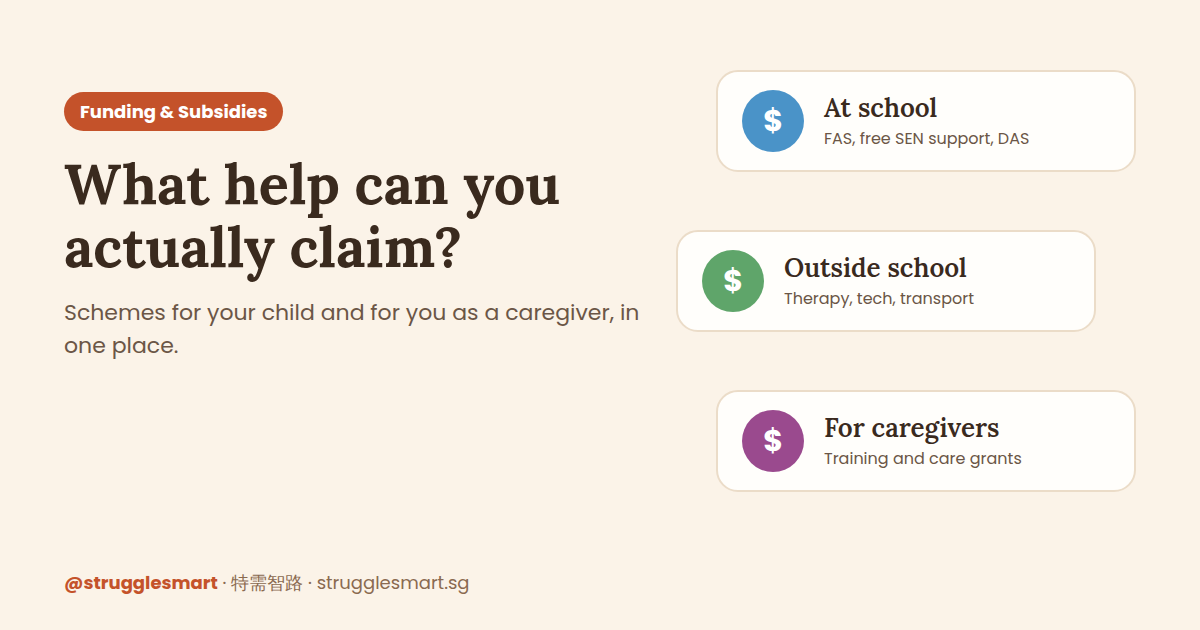
This guide groups them in two: help for your child (at school, and outside school) and help for you as a caregiver. Click any coloured box in the map just below to jump straight to that section.
CLICK OR TAP ANY COLOURED BOX BELOW to jump to that section and read the details.
There is no single total: what you get depends on your income and your child's needs.
Many schemes depend on the type of disability, not just a diagnosis.
The Assistive Technology Fund, GOAL+ and the Special Needs Savings Scheme list categories such as autism, intellectual disability, and moderate hearing, visual or physical disability. ADHD or dyslexia on their own are usually not on those lists. For these children, the main help is school support, healthcare subsidies and DAS.
Most are means-tested. Have household income documents ready.
You will need a report. A diagnosis or disability verification from a registered doctor or psychologist.
MOE said in 2022 that SEN support in mainstream schools comes at no extra cost to parents. That covers learning support in reading and maths and your school's SEN officer. Eligible primary students also get MOE-funded devices. In secondary school and JC, eligible students pay 5% of the device cost, capped at $50.
For mainstream and SPED schools, 2026 eligibility is gross household income of $4,000 or less a month, or per capita income of $1,000 or less. At primary level this means:
Apply through your child's school. SPED school fees were about $14 to $250 a month for citizens in 2022. Check the school for the current fee.
MOE part-funds the DAS Main Literacy Programme (MLP). You need a dyslexia diagnosis and your child must be in an MOE mainstream school, with at least 75% attendance. Secondary students enrolling from January 2026 who scored AL1 to AL5 in PSLE English (Standard) are not eligible.
Important: a child can attend only one MOE-funded programme. If your child attends school-based dyslexia remediation (SDR), the MLP subsidy cannot be claimed. Families can do both and pay the full DAS rate, or choose one.
DAS lists MLP per term (Singapore Citizens): about $515 to $567 subsidised, against $1,476 to $1,637 standard. DAS bursaries of 33% to 100% are available to needy Singaporean families.
Subsidy of up to 90% of equipment cost, with a lifetime cap of $40,000. Needs a permanent disability in a listed category (including autism), and an assessment. From January 2026 the income limit is $4,800 per person per month. A therapist or social worker at an approved Touchpoint applies for you.
A $400 grant with a $200 top-up each year, unused amounts carried forward up to $400 per care recipient. It offsets approved training courses. DAS says the grant is available to DAS parents for DAS Academy workshops and courses, which teach you how to support your child's learning at home. DAS does not publish workshop fees on these pages, so check DAS Academy for current fees and eligibility.
From April 2026, up to $600 a month: $600 if per capita income is $1,500 or less, $400 for $1,501 to $3,600, $200 for $3,601 to $4,800. Your child must permanently need help with at least three daily activities such as feeding or dressing. That means it fits significant physical or intellectual needs, and is unlikely to apply to ADHD or dyslexia alone.
Our view at StruggleSmart: ask early and ask again, because schemes change. Eligibility is narrower than parents expect, and the gap for ADHD and dyslexia is real. And before paying for private therapy or tuition, ask what outcome to expect and how progress will be measured.
Not sure which of these fits your child? Email hello@strugglesmart.sg with your child's age and situation (no names needed), or visit strugglesmart.sg, and we will point you to where to look first.
Sources: SG Enable Enabling Guide; Assistive Technology Fund; EIPIC-P; SSCCs; GOAL+; Special Needs Savings Scheme; ECDA DS-Plus; MOE SPED FAS; MOE FAS 2026; MOE reply, 9 May 2022; MOH reply, 16 Feb 2024; MOH on ADHD and MediSave, 2016; Together for Better, caregiver grants; DAS programme fees and subsidy; DAS, how parents can help. Some figures (SPED fees, MOE devices, MediSave and ADHD) come from older replies. This is general information, not financial or legal advice. Please confirm current details with the agency before applying.