Most parents of a child with special needs in Singapore find out about school support the same way: from another parent, in a chat group, usually after something has already gone wrong.
"Has he been put in LSP?" "Ask for SDR." "My girl is in ABLE for Chinese." Everyone seems to know the letters, and nobody explains them.
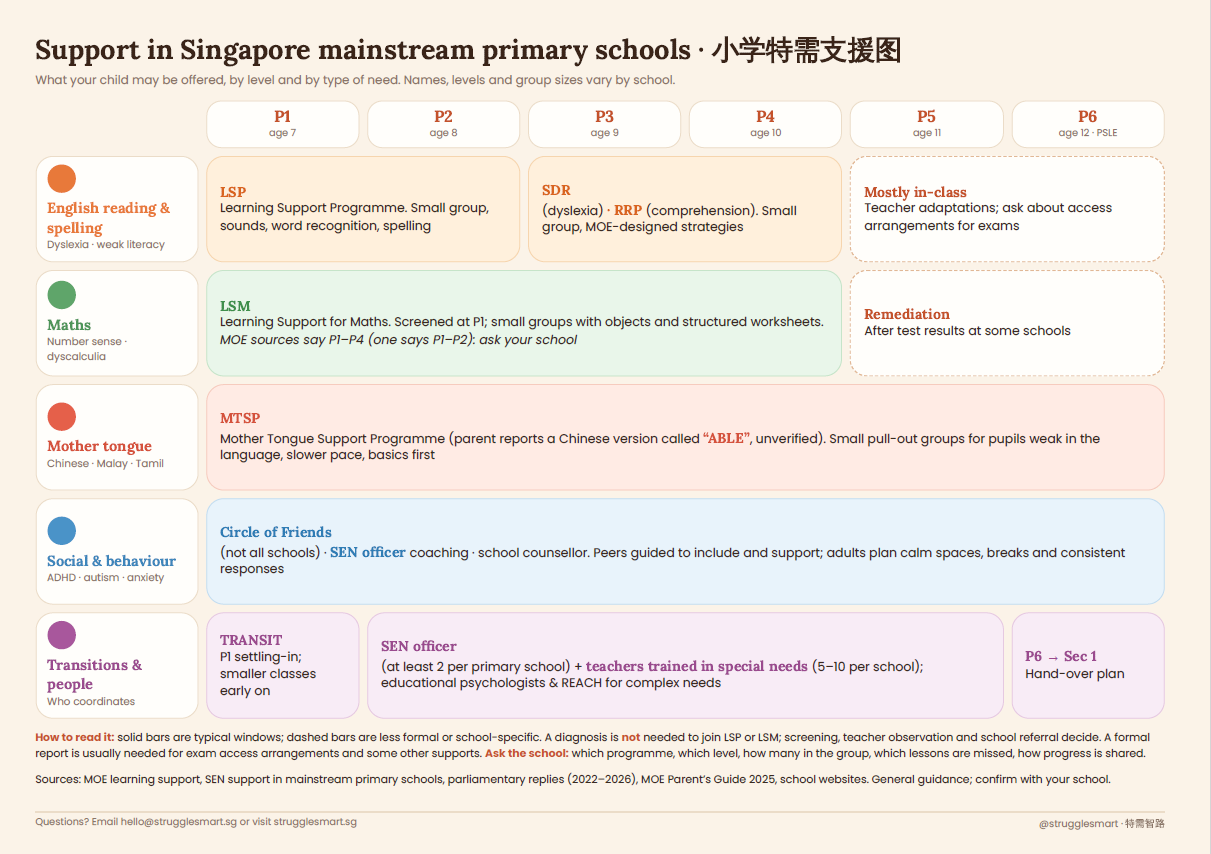
This guide does that. It sets out what mainstream primary schools generally offer, what is done differently in each programme, and what to ask your own school, because names, levels and group sizes vary from school to school. We have also made a one-page map and a printable starter kit, linked at the end.
About 80 per cent of students with special educational needs (SEN) in Singapore are in mainstream schools, according to MOE figures reported by The Straits Times in May 2026. So these supports are how most children with learning, attention and social differences are helped every day.
Support comes in layers:
One point matters more than any other. You do not need a diagnosis for your child to join most of these programmes. Schools identify needs through screening in Primary 1, teacher observation and test results. A formal assessment is mainly needed for things like exam access arrangements.
Learning Support Programme (LSP): early reading and spellingLSP is for lower primary pupils who struggle to read and spell. Instead of keeping up with the whole class, your child joins a small group, usually in a separate room and in addition to regular English lessons. The teaching goes back to the building blocks: sounds, recognising words, spelling. It is taught step by step, with a lot of repetition, until it sticks. Pupils leave the programme when they catch up. School websites show it running at Primary 1 and 2.
Learning Support for Mathematics (LSM): number senseChildren are screened for maths at Primary 1, and those who need it learn in small groups. What is done differently is that the teaching is concrete. Pupils use objects and structured worksheets, and the teacher uses diagnostic questions to find out exactly where understanding breaks, instead of repeating the same lesson louder. One note: MOE sources do not agree on how long it runs. The MOE learning support page says Primary 1 to 4, while the 2025 Parent's Guide says Primary 1 to 2. Ask your school which levels it covers.
School-based Dyslexia Remediation (SDR): for dyslexia, usually Primary 3 to 4SDR uses MOE-designed strategies for reading and spelling, taught in small groups by trained teachers. The teaching is explicit and multi-sensory, with the pace slowed right down so a child who has been decoding with great effort gets a method, not more of the same. Many families use SDR together with an outside programme. SDR is run by the school, separate from outside options such as the DAS Main Literacy Programme.
Reading Remediation Programme (RRP): when a child reads but does not understandSome children read aloud fluently and still cannot answer comprehension questions. RRP, which school websites place at Primary 3 to 4, teaches comprehension strategies directly: predicting, asking questions, finding the main idea, going back and re-reading. That makes it different from LSP and SDR, which are about getting words off the page.
Mother Tongue Support Programme (MTSP): and what about ABLE?MTSP gives extra help in Chinese, Malay or Tamil for pupils who find the language hard, often because it is not spoken at home. Pupils are pulled out in small groups for part of the week, and teaching starts with the basics at a slower pace. MOE material has described group sizes of about 5 to 8 in 2019 and 8 to 12 in 2024.
Some parents have told us their child is in a Chinese programme called ABLE. We could not find ABLE on any MOE page or school website, so we cannot confirm what it is. It may be the name one school uses for its own mother tongue support. If your child is in a programme with a name you do not recognise, ask the school what it is called officially, who it is for, and what it covers.
TRANSIT: settling into Primary 1Primary 1 is a big jump. TRANSIT supports children who need help adjusting, and some schools use smaller classes with extra adult attention at the start of the year. The focus is routines, social skills and school readiness. How long it lasts is reported differently: one teacher quoted by The Straits Times said until Term 3, while another source says Term 4. Ask how pupils are chosen and when the move to regular class size happens.
Circle of Friends: support from classmatesFor a child with social or behavioural needs, the school works not only with the child but also with a small group of classmates. They are guided by the SEN officer on how to include and help. MOE says staff in all schools have been trained in it since 2021, but not every school uses it, and a 2023 evaluation showed improvements. If your child is being left out or struggles with friendships, ask if your school runs it. It is also worth discussing how information about your child is shared with classmates.
SEN officers. Every primary school has at least two. The number across mainstream schools has grown from 450 in 2017 to 820. They help identify needs, plan adjustments and connect families with programmes and outside services.
Teachers trained in special needs. Each school has about 5 to 10. They teach regular classes but are trained to adapt lessons and spot difficulties early.
School counsellors and educational psychologists. Brought in when a child's needs are more complex, along with outside services such as REACH.
Experience varies a lot. Some parents describe an officer who met their child before Primary 1 and followed up regularly. Others never met their officer at all. Teachers are also stretched, often with many different needs in one class, so the most effective approach is a partnership: offer a short, practical note on what works, and thank people when it does.
You do not need to wait for an assessment to ask these. Asking before the school year starts gives them time to arrange things.
Write the answers down. "We will keep an eye on it" is not a plan, and you are allowed to ask what exactly will be done, by whom, and how often.
Know the menu before you ask. Parents who ask for "SDR" in Primary 1 are usually told it does not start yet. Parents who ask "what is available for reading at my child's level?" get a real answer.
Small-group support is a bridge, not a label. These programmes are meant to help children catch up or cope. Being in one is not a verdict on your child.
Home helps the programme work. Fifteen minutes of calm, predictable practice and a good night's sleep do more than another worksheet. Our starter kits on mornings, meltdowns, homework, after-school crashes and bedtime are built for these moments.
Check, then check again. Schools adapt MOE frameworks to their own pupils and staff, so what we describe here is a general picture. The most reliable answer is always your own school's.
We have turned this guide into a one-page map showing primary levels, types of need (reading and spelling, maths, mother tongue, social and behaviour, transitions) and the supports usually offered at each stage. There is also a printable Primary School Support Starter Kit with the map, a conversation checklist for your school, a one-page learning profile to hand to teachers, and a programme tracker. Both are free to download.
If you would like to talk through any of this, email hello@strugglesmart.sg or visit strugglesmart.sg.
Sources: Ministry of Education Singapore, learning support in primary schools; SEN support in mainstream primary schools; parliamentary reply on the Circle of Friends initiative, 26 February 2025; MOE parliamentary replies on learning support programmes (4 November 2025), TRANSIT (1 August 2022), SEN officers and trained teachers (14 October 2024) and assessment stages (3 February 2026); MOE Parent's Guide 2025; school websites. Enrolment and SEN officer figures: The Straits Times, 27 May 2026. ABLE is parent-reported and not confirmed by MOE. This is general guidance for educational purposes and not a substitute for advice from your child's doctor, psychologist, school or MOE. Programmes and figures change, so please confirm current details with your child's school.